
Jobs and opportunities
One certificate.
Job sites
everywhere.
Commercial divers work where nobody else can go. The demand is real and the market is open. Your DCBC certificate gets you in as soon as you finish the program.
What's ahead
Few divers.
Plenty of work.
There aren’t many commercial divers. There is no shortage of job sites, though: infrastructure to inspect, structures to repair, port work, offshore projects. The market runs from Eastern Canada to job sites around the world.
All graduates find work quickly. The ETSM network and the internship at the end of the program make that transition easier.
Careers move fast for divers who keep logging hours underwater. Diver, supervisor, diving safety specialist: each step brings new contracts and better conditions.
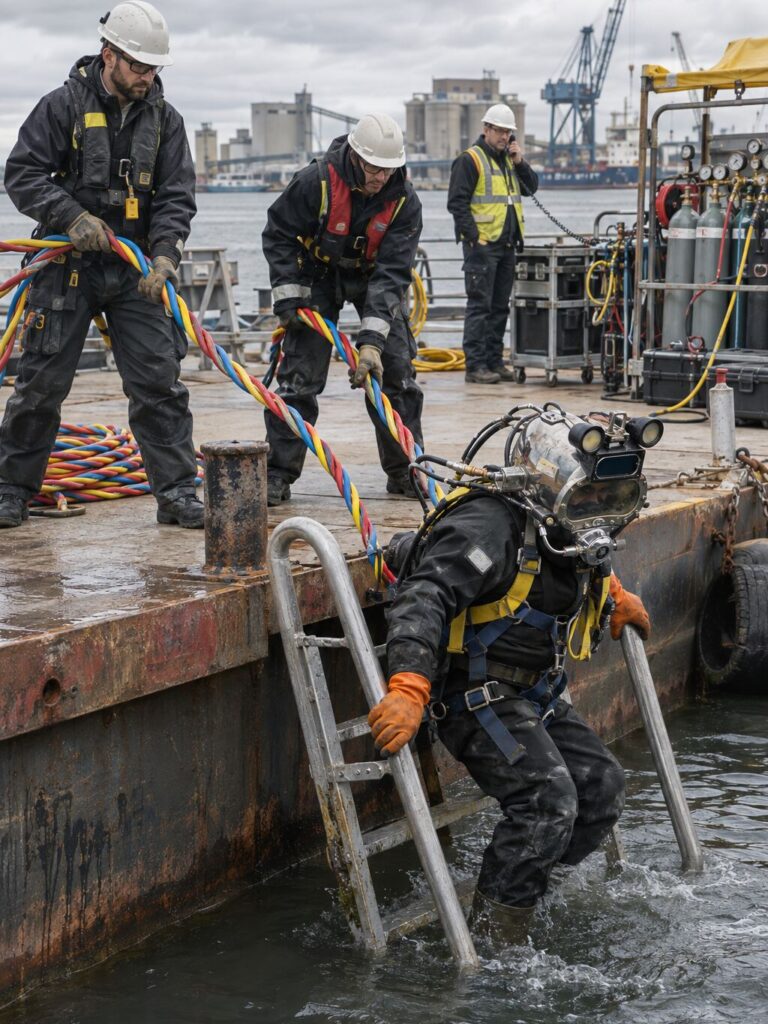
Where graduates work
Industries
The DCBC Unrestricted Surface Supplied Diver certificate opens the door to a wide range of job sites. These are the sectors that hire commercial divers on a regular basis.
Infrastructure and civil engineering
Inspecting and repairing bridges, dams, piers, water intakes and submerged concrete structures. A large share of the work in Quebec.
Port and marine work
Wharf maintenance, hull inspection, installing underwater structures and dredging in ports and coastal areas.
Oil, gas and offshore
Inspecting, installing and maintaining subsea pipelines, and working on platforms and other offshore installations. These job sites are often abroad.
Hydroelectricity and energy
Maintenance on hydroelectric plant infrastructure, dams and penstocks. An active sector in Quebec and Ontario.
Inspection and non-destructive testing
Assessing the condition of submerged structures, recording video and writing job site reports. A technical role that clients value highly.
Salvage
Recovering submerged equipment, vehicles or wrecks. Emergency work for public services and marine insurance companies.
Moving up in the trade
Career progression
Hours underwater count. The more you log, the more roles open up to you and the more responsibility you take on.
Diver
You start out on job sites with your DCBC certificate: technical work, inspection, welding, concrete. You build up dive hours and job site experience.
Experienced diver
As your hours add up, crews start relying on you for complex jobs. Clients and companies ask for you by name.
Diving supervisor
You run operations from the surface, manage the crew and keep the job site safe. This role requires an additional certification and several years of experience.
Diving safety specialist
Full management and quality control of diving safety rules.
Where you'll work
Quebec, Canada
and abroad
The DCBC certificate is recognized across Canada. It gives access to federal job sites, coastal projects in the Maritime provinces and major projects in Western Canada.
- Quebec
- Ontario
- Maritimes
- British Columbia
- North Sea
- Gulf of Mexico
- Middle East
- International offshore
Recognition
Across Canada
The DCBC certificate is the national standard for commercial diving work
Markets open to you
Federal and international
Government job sites, offshore, major infrastructure projects
End-of-program internship
1 week in the industry
ETSM helps place you with partner companies
Day to day on the job
Working conditions
Commercial diving is physical work, and it changes all the time. Every job site is different: the setting, the depth, the crew, how long it lasts. Here is what you should know before you commit.
What the job offers
- Pay above the average for construction trades
- Frequent overtime on large job sites
- Rotation work: intensive stretches followed by time off
- A wide variety of contracts and work settings
- Access to international job sites with the same certificate
- Fast progression for those who put in the effort
What you have to accept
- Conditions that are sometimes tough: cold, low visibility, currents
- Frequent travel, sometimes far from family
- Physically demanding work: heavy gear, sustained effort
- Strict safety requirements you follow at all times
- Medical and technical certifications to keep current throughout your career
The ETSM advantage
The network is part
of the training
Every ETSM instructor works in the industry. They know the companies, the job sites and the supervisors, and every graduate has access to that network.
An industry internship is mandatory at the end of the program. ETSM helps place students with companies so they get a first taste of real job site work.
The instructors point graduates toward the job market. A first contact in the industry is often worth more than a polished resume.
The school has a good name in the industry, and employers recognize an ETSM diploma.
Ready to get started
The next cohort starts in March
Space is limited. If you have questions about the program, the requirements or job prospects, the ETSM team will answer you directly.
